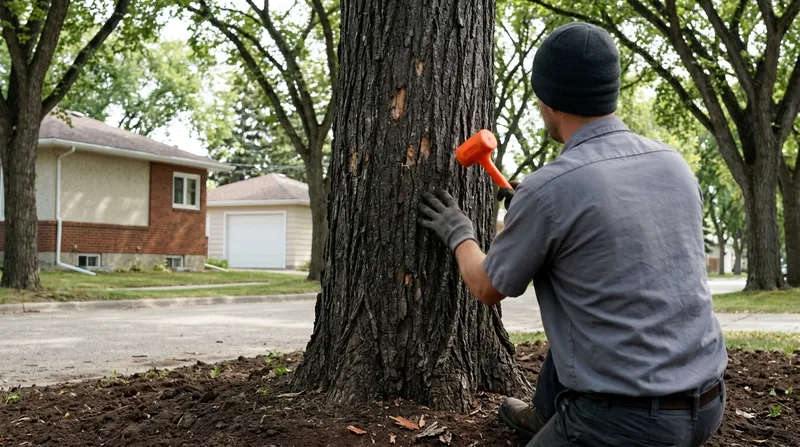




A written arborist report and risk assessment documents the condition of a tree and the hazard it may pose to property, people or utilities. In Winnipeg, where American elms arch over older streets, green ash lines newer boulevards, and self-seeded in Winnipeg and the surrounding area maples crowd back lanes, this assessment becomes critical before removal, before sale, after storm damage, or when a neighbour's tree threatens a fence or roof. Our ISA Certified Arborists examine species, structural integrity, disease, pest damage and proximity to buildings and power lines, then deliver a detailed report suitable for insurance claims, property transactions, municipal applications and legal disputes. We have served the Winnipeg area since 2014 and understand the clay soils, wet snow loading and local pest pressures that shape tree health here.
Why an arborist report matters in the Winnipeg area
A tree that appears sound to the eye may harbour internal decay, root failure or structural weakness invisible without professional inspection. Winnipeg's heavy wet snow, wind gusts and the prevalence of Dutch elm disease and emerald ash borer mean that risk assessment is not a luxury but a practical safeguard. Insurance companies, municipal planners and property lawyers all demand a certified assessment before they will act on a claim or approve a transaction. Without one, you may face denial of coverage, costly disputes with neighbours or unforeseen liability if a tree fails.
- We identify dead wood, cavities, cankers and signs of disease or insect damage that compromise safety.
- We assess lean, root collar damage and structural defects that increase failure risk.
- We measure height, spread and proximity to structures and utilities to quantify hazard.
- We document findings with photographs and technical notes for your insurer or legal file.
- We recommend remedial action: pruning, cabling, monitoring or removal.
A professional assessment protects you legally and financially, and gives you confidence in your tree management decisions.
Local example: A mature American elm in St. James with a 45-degree lean and visible root collar damage over a detached garage poses imminent failure risk. An arborist report quantifies that risk, documents it for insurance and informs whether cabling or removal is the appropriate response.
How we conduct an assessment
Our process combines visual inspection, close-range examination and professional judgment. We climb or use a bucket lift to inspect the crown and upper trunk, probe for decay with a resistograph, check for pest galleries and assess branch attachment angles. We photograph key findings and measure distances to nearby structures. For trees near in Winnipeg and the surrounding area Hydro lines, we note the approach distance and flag any hazard to the electrical service entrance. The result is a written report with findings, risk rating and recommendations, suitable for immediate action or long-term planning.
- We examine the crown for dead wood, crossing branches and signs of disease or pest activity.
- We inspect the trunk for cavities, cracks, cankers, root collar damage and lean.
- We probe suspect wood and assess structural integrity with precision tools.
- We measure distances to buildings, fences, power lines and other assets at risk.
- We photograph and document findings for your file.
- We deliver a written report with risk rating, findings and recommendations within 48 hours.
This methodical approach ensures your report is thorough, defensible and actionable. Whether you need it for an insurance claim, a property sale or a municipal application, we deliver the evidence you need. For more on how we approach tree safety, see our page on tree cabling and bracing.
Real scenario: A homeowner in Assiniboia suspects a large bur oak is dying after construction damage. An arborist report documents the root collar injury, reduced crown vigour and failure risk, then recommends a two-year monitoring plan with annual follow-up. The report protects the homeowner in any future dispute with the contractor and guides proper care.
Report methods and assessment tools
| Method | Description | When used |
|---|---|---|
| Visual inspection | Crown assessment, bark condition, branch angles, visible defects and pest signs. | All assessments, ground and aerial. |
| Resistograph testing | Drilling a small needle through the trunk to measure wood density and detect internal decay. | When decay is suspected but not visible from outside. |
| Close-range climbing | Hands-on inspection of branches, bark and upper trunk using ropes and harness. | Large or complex trees; detailed assessment of crown structure. |
| Measurement and photography | Documenting height, spread, proximity to structures and hazards; photographic record for your file. | All assessments; essential for insurance and legal claims. |
| Pest and disease diagnosis | Identification of Dutch elm disease, emerald ash borer, cankers and other threats specific to in Winnipeg and the surrounding area species. | When elm, ash or other pest-prone species show signs of decline. |
| Risk rating | Professional judgment on failure probability and consequence, rated as low, moderate or high hazard. | All assessments; determines urgency of remedial action. |
Each report is tailored to your situation. If the tree is near in Winnipeg and the surrounding area Hydro lines, we note the distance and recommend clearance if needed. If it shows signs of elm disease, we advise on the provincial pruning ban (April 1 to July 31) and disposal rules. If it is a high-value specimen or a legal dispute is pending, we provide additional detail and expert opinion. Our reports are accepted by insurers, municipal planners and courts across in Winnipeg and the surrounding area.
When to order an arborist report in Winnipeg neighbourhoods
Timing matters. Order a report before you decide whether to keep, prune or remove a tree. Order one before selling your property, before major construction, after a storm, or when a neighbour disputes a boundary tree. In Winnipeg, spring and early autumn are ideal for detailed inspection because trees are in leaf and defects are visible; however, structural assessment can be done year-round. For elm specifically, any assessment or work must respect the April 1 to July 31 provincial ban on pruning.
- Before a property sale: document tree condition and any hazards for disclosure and negotiation.
- After storm or snow damage: assess whether the tree can recover or must be removed.
- When a tree shows decline: diagnose the cause and recommend treatment or removal.
- In a neighbour dispute: provide neutral, expert documentation of the tree's condition and risk.
- Before construction near a tree: assess root and crown clearance and predict survival.
- For insurance claims: document damage and establish the cause for your insurer's file.
Do not wait for a tree to fail. A proactive assessment costs far less than emergency removal or property damage. Contact us at (431) 441-0851 for a free estimate, or visit our contact page to request an assessment.
Regulatory context and what we check for you
The City of Winnipeg manages trees on public land and boulevards; only the municipality may prune or remove those trees. For a tree on your own property, there is generally no permit required. However, elm is a special case: the provincial government bans all pruning of elm from April 1 to July 31, and elm wood must be disposed of according to provincial rules to prevent spread of Dutch elm disease. If your tree is near in Winnipeg and the surrounding area Hydro's distribution lines, we maintain safe approach distances and flag any hazard; we never work on the public network itself. When you order an assessment, we check these rules for your address and advise you on any restrictions that apply. We document our findings in a way that satisfies municipal, provincial and insurance requirements, so you can move forward with confidence.
For more on disease-specific assessment, see our pages on Dutch elm disease assessment and emerald ash borer assessment. If your tree needs removal or remedial work, we offer tree removal and tree trimming services. All our crews are fully insured and our arborists hold ISA certification.
Prices Arborist Report & Risk Assessment in Winnipeg — Indicative pricing
| Service | Price | Details |
|---|---|---|
| Standard arborist report (trees up to 15 metres) | From $215 | Visual inspection, risk assessment, written report with photographs and recommendations. |
| Detailed assessment with resistograph testing | From $325 | Includes decay detection, structural analysis and expert opinion for insurance or legal claims. |
| Multi-tree property survey | From $495 | Assessment of three to five trees on the same property, one comprehensive report. |
| High-risk or large-specimen assessment | By quote | Complex trees, climbing required, extensive photography or expert testimony for court. Free on-site evaluation. |
| Travel | Included | In Winnipeg and the surrounding area. |
| Free estimate | Always free | Call (431) 441-0851 or request a quote online. Response within 24 hours. |
Indicative prices; free, personalized estimate within 24h at (431) 441-0851.