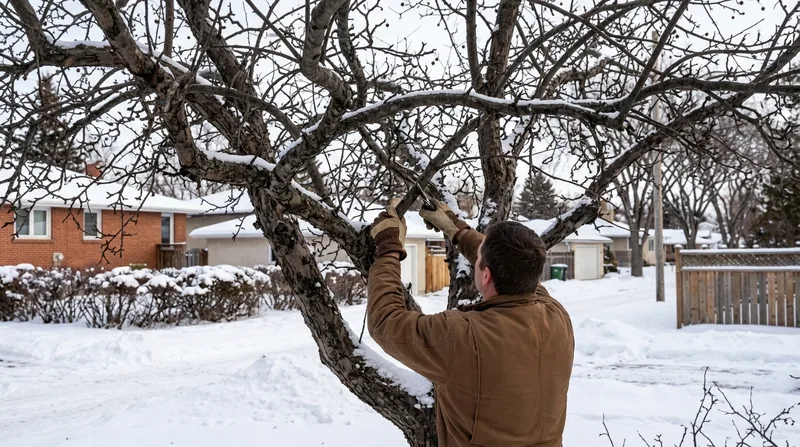




Fruit tree pruning in Winnipeg keeps your apple, crabapple, plum and cherry trees productive and healthy through the short growing season. On the Winnipeg area's heavy clay and with our intense summer heat, fruit trees need deliberate pruning to open the canopy, remove water sprouts, and bring neglected old trees back into useful bearing. Red River Tree Trimming has pruned fruit trees across Winnipeg and the surrounding municipalities since 2014, working with ISA Certified Arborists who understand how to balance vigour with fruit production on a tight timeline.
Why Fruit Tree Pruning Matters in Winnipeg
Fruit trees planted decades ago in Winnipeg backyards often become overgrown, dense and unproductive. Without regular pruning, the centre fills with crossing branches, water sprouts crowd out fruit buds, and disease settles into the dark interior. A mature apple or crabapple tree can live 50 years or more, but only if we remove dead wood, thin competing growth, and restore an open, airy structure. This work is best done in late fall through late winter, when the tree is fully dormant and we can see the branch architecture clearly.
- We remove dead, diseased and crossing branches to prevent fungal issues and storm damage.
- We thin water sprouts and vigorous upright shoots that steal energy from fruit production.
- We open the centre of the crown to let light reach inner branches and improve air circulation.
- We cut to an outward-facing bud at a 45-degree angle to encourage healthy new growth.
- We respect the tree's natural form and avoid excessive heading back, which triggers more water sprouts.
A well-pruned fruit tree bears more reliably, resists pests and disease, and lives longer. On the Winnipeg area's short season, this attention pays off in heavier crops and cleaner fruit.
Key info: A typical mature apple or crabapple tree in Winnipeg takes 2 to 4 hours to prune properly. Neglected trees that have not been touched in 10 years may need a two-stage renewal, with the second pruning 12 months later to manage regrowth.
How We Prune Your Fruit Trees
Our arborists assess each tree's age, variety, vigour and fruiting history before making a cut. We do not follow a template. A young tree getting its first structural pruning needs different work than a 40-year-old neglected crabapple. We use hand pruners on branches under 2 centimetres, loppers on wood up to 4 centimetres, and a sharp pruning saw for larger limbs. All cuts are made just outside the branch collar, where the branch meets the trunk, to allow the tree to compartmentalize the wound and heal naturally.
- We inspect the tree for dead wood, disease cankers, and storm damage before the growing season begins.
- We remove any branches that cross, rub or grow inward towards the centre of the crown.
- We cut out water sprouts and suckers at their base to prevent regrowth.
- We thin the upper crown to allow light penetration to lower fruit-bearing wood.
- We haul all brush and prunings to the curb or chip them on site if you wish.
After pruning, your tree will look noticeably smaller and more open. This is normal and necessary. Fruit trees respond to this work by producing more flower buds the following spring, leading to a heavier crop in summer.
Real example: A 35-year-old McIntosh apple tree in St. James had not been pruned in 12 years and bore only scattered small fruit. After a full structural pruning in February, removing about 40 per cent of the crown, it produced a full crop the following August. The fruit was larger, cleaner, and easier to pick.
Pruning Techniques for Common Fruit Trees in the Winnipeg Area
| Tree Type | Pruning Goal | Timing |
|---|---|---|
| Apple & Crabapple | Open vase form, remove crossing branches, thin water sprouts | Late October to late March |
| Plum | Thin centre, remove dead wood, promote lateral fruiting spurs | Late October to late March |
| Cherry | Light thinning, remove crossing limbs, preserve natural pyramidal form | Late October to late March |
| Young trees (under 10 years) | Establish strong scaffold branches, remove competing leaders | Late October to late March |
Fruit trees in the Winnipeg area respond best to dormant-season pruning. Pruning in summer or early autumn can stimulate tender new growth that will not harden off before frost. Winter pruning, after the first hard freeze, avoids this risk and allows us to see the tree's structure clearly without foliage.
Timing and Regulatory Considerations in Winnipeg
Fruit trees on private property in Winnipeg do not require a municipal permit. However, if your apple or plum tree is an elm (which is rare for a fruit tree), the provincial elm pruning ban applies: elm pruning is strictly forbidden from April 1 to July 31 everywhere in in Winnipeg and the surrounding area. We check the rules for your address and ensure all work respects approach distances near private electrical service entrances. If your tree touches a in Winnipeg and the surrounding area Hydro line on public right-of-way, we refer that hazard directly to the utility. For your own private service entrance, we maintain safe clearance and never work on the public distribution network.
Structural pruning of apples, crabapples, plums and cherries is best done in late fall to late winter, when the tree is fully dormant. This timing minimizes stress, reduces disease risk, and allows the tree to respond with vigorous spring growth. Spring and summer pruning is reserved for removing storm damage or dead wood only.
We haul all prunings to the curb for collection by the City of Winnipeg, or we chip the material on site if you prefer. Wood disposal is included in our service. For more details on how we manage storm damage and emergency removals across the Winnipeg area, see our page on storm and snow load cleanup.
Getting Your Fruit Trees Back into Production
Neglected fruit trees are common in older Winnipeg neighbourhoods, where many backyards have mature apples, crabapples or plums that have never received professional attention. These trees are often still vigorous and worth restoring. Our ISA Certified Arborists evaluate each tree's condition, health and potential before recommending a pruning plan. Some trees need a single intensive pruning; others benefit from a two-stage approach, with a follow-up pruning 12 months later to manage the regrowth.
After pruning, fruit trees typically recover quickly and produce heavier crops within one to two years. The investment in professional pruning pays for itself in improved yields and easier maintenance. Call us at (431) 441-0851 for a free estimate on your fruit trees, or visit our contact page to request a site visit. We serve Winnipeg, West St. Paul, East St. Paul, Springfield, Selkirk and all surrounding municipalities. For a complete overview of our tree pruning and crown reduction services, see our main pruning page.
Prices Fruit Tree Pruning in Winnipeg — Indicative pricing
| Service | Price | Details |
|---|---|---|
| Small fruit tree (under 6 metres, light pruning) | From $145 | Young or well-maintained apple, crabapple or plum tree |
| Medium fruit tree (6 to 10 metres, moderate renewal) | From $275 | Mature tree needing structural work and water sprout removal |
| Large or neglected fruit tree (over 10 metres, heavy renewal) | From $425 | Old tree not pruned in many years; may require two-stage pruning |
| Two-stage renewal (12-month follow-up) | From $225 | Second pruning to manage regrowth after heavy initial work |
| Free estimate and site visit | Included | Call (431) 441-0851 or request online; response within 24 hours |
Indicative prices; free, personalized estimate within 24h at (431) 441-0851.