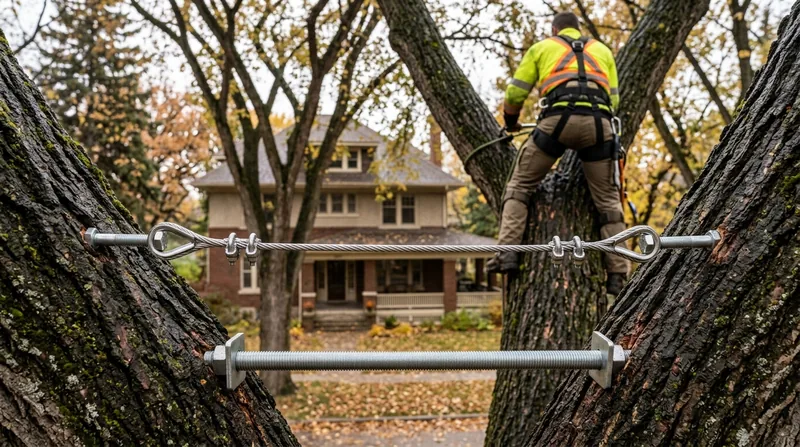




Tree cabling and bracing in Winnipeg keeps mature trees standing when structural weakness or storm damage threatens removal. The Winnipeg area is home to the largest urban elm canopy on the continent, and many of these American elms arch over older streets with weak unions or cracked scaffold limbs. Rather than fell a 60-year-old elm, our ISA Certified Arborists install flexible cabling and bracing systems that redistribute load and allow the tree to remain as a landmark. We have served Winnipeg and the surrounding municipalities since 2014, and we understand the specific challenges of this landscape: heavy wet snow loading on leafed-out trees, summer windstorms, and the clay soils that stress root anchorage. A free estimate takes 20 minutes on site.
Why cabling and bracing keeps your mature elm standing in Winnipeg
An American elm with a V-shaped crotch or a horizontal crack in a major limb does not need to come down. Cabling and bracing redistribute the mechanical load across weak points, allowing the tree to heal and remain functional. In Winnipeg, where these elms are irreplaceable streetscape features, preservation is almost always the better choice. Storm damage, heavy snow, or age can compromise the structure of a limb; cabling does not repair the wood, but it prevents catastrophic failure and buys time for the tree to compartmentalise its wound.
- We assess the tree for crack direction, union angle, and load path to design a system that works with the tree's natural growth.
- We install cable at the proper height and tension, never girdling the bark or creating stress points.
- We use galvanised steel or synthetic cable rated for the species and limb diameter.
- We check the system annually and adjust as the tree grows.
Cabling extends the life of a weakened tree by 10 to 20 years, and in many cases far longer. The investment is a fraction of removal and stump grinding.
Local insight: A 55-year-old American elm in Silver Heights with a 40-degree crotch angle and early radial cracking costs $850 to cable and brace. Removal of the same tree runs $2,100 to $3,200 plus stump grinding. Cabling buys decades of shelter and canopy.
How we install cabling and bracing systems
Our process begins with a detailed structural inspection. We photograph the weak union or crack, measure limb diameter and angles, and assess the overall health of the tree. If cabling is the right choice, we schedule the work during dormancy (late fall through late winter) when the tree is not actively growing and the risk of bark damage is lowest. For elm, we strictly observe the provincial pruning ban from April 1 to July 31, so winter is the only window for structural work on these trees. We then install the cable system using climbing techniques that minimise bark abrasion, and we verify the tension and anchor point placement before we leave the site.
- We climb the tree using rope and harness, never using spikes on living wood.
- We drill anchor points at the correct height and angle to create a balanced load distribution.
- We thread galvanised cable through the anchor points and tension it to the manufacturer's specification.
- We cap all anchor holes with wound dressing to seal the entry point.
- We document the system with photos and provide you with a maintenance schedule.
The entire job typically takes 2 to 4 hours for a single-limb system and 6 to 8 hours for a multi-limb assembly. We clean up all debris and haul away any cut wood.
Real example: A 70-year-old basswood in West St. Paul with a cracked 60-centimetre scaffold limb overhanging a garage received dual cable bracing in January. The homeowner saved the tree and the shelter it provided. Two-year check-up showed the crack had compartmentalised and the limb was stable. Total cost:$1,200 installed and first-year monitoring.
Cabling methods and systems for different tree structures
| System type | Description | Best for |
|---|---|---|
| Single cable between limbs | One length of cable anchored in both limbs, reducing the span and load on the weak union. | V-crotch elms, two major codominant stems. |
| Dual cable (parallel) | Two cables installed side by side for heavier limbs or steeper angles. | Large basswood or cottonwood limbs with radial cracks. |
| Bracing rod | A rigid metal rod installed horizontally to lock limbs in place and prevent sway. | Horizontal limbs or trees in high-wind areas. |
| Multi-limb system | Multiple cables and rods installed across three or more limbs to stabilise the entire crown. | Storm-damaged trees or trees with multiple weak points. |
We choose the system based on tree species, limb diameter, angle, and the severity of the structural defect. An American elm with a 35-degree crotch angle typically needs a single cable; a in Winnipeg and the surrounding area maple with multiple horizontal limbs and heavy snow loading may need a multi-limb assembly. Our arborist report and risk assessment service provides a detailed written recommendation if you are uncertain whether cabling is the right choice.
Regulatory and safety considerations in the Winnipeg area
Cabling and bracing on private property requires no municipal permit in Winnipeg. However, if the tree is an American elm, we check the provincial regulations before we begin: elm pruning and any work that wounds elm wood is banned from April 1 to July 31 across in Winnipeg and the surrounding area. We schedule all elm cabling work in late fall, winter, or early spring to comply with this rule. If the tree is located near a in Winnipeg and the surrounding area Hydro service line (the wire running from the pole to your house), we maintain safe approach distances and never work on or touch the public distribution network. We are fully insured and carry liability coverage for all structural climbing work. A copy of our insurance certificate is available on request.
After installation, the cabling system requires annual inspection. We recommend a brief check-up each spring to verify cable tension, inspect the anchor points for corrosion, and confirm that the tree is healing normally. Neglected systems can lose tension and fail to provide support, so routine monitoring is part of responsible stewardship.
When to cable and brace trees in the Winnipeg area
Structural pruning and cabling are best done during dormancy (late fall through late winter) when the tree is not actively growing and the risk of stress or infection is lowest. For elm, the window is even narrower: we must complete all work by March 31, before the April 1 provincial pruning ban takes effect. For other species like ash, basswood, or cottonwood, we can work from November through March. If a limb is actively cracked or poses an immediate safety risk, we can assess the situation year-round and recommend emergency measures; however, we avoid major structural work during the growing season unless the tree is in danger of failure.
Storm damage in summer or heavy wet snow in spring can create urgent cabling needs. We respond to emergency calls 24/7 and can install temporary support or assess the damage within hours. Contact us at (431) 441-0851 if you discover a cracked limb or suspect structural weakness after a windstorm.
Cabling versus removal: how to decide
Cabling preserves a tree; removal ends its life. The choice depends on the tree's age, species, location, health, and the severity of the structural defect. A 60-year-old American elm with a weak crotch but otherwise healthy foliage and no signs of disease is almost always worth cabling. A 40-year-old green ash with early emerald ash borer symptoms and a cracked limb may be a candidate for removal instead, because the tree's lifespan is already limited. We provide a free assessment and honest advice. If cabling is not the right choice, we can discuss tree removal and stump grinding as alternatives. Our goal is to help you keep trees that are worth keeping and remove trees that pose a genuine risk.
Call us at (431) 441-0851 or visit our contact page to request a free estimate. We serve Winnipeg, West St. Paul, East St. Paul, Springfield, Tache, St. Clements, St. Andrews, Selkirk, Stonewall, Cartier, St. Francois Xavier, and Niverville.
Prices Tree Cabling & Bracing in Winnipeg — Indicative pricing
| Service | Price | Details |
|---|---|---|
| Single cable system (one weak union) | From $750 | Includes drilling, cable installation, anchor capping, and documentation for a single limb or crotch. |
| Dual cable system (larger or multiple weak points) | From $1,200 | Two parallel cables or one cable plus a bracing rod for heavier limbs or steeper angles. |
| Multi-limb system (storm damage or complex structure) | From $1,800 | Three or more cables and rods across the crown; includes detailed assessment and load distribution design. |
| Annual monitoring and re-tensioning | From $200 | Spring check-up, tension verification, and minor adjustments to maintain system performance. |
| Free estimate and structural assessment | Free | On-site inspection, photographs, and written recommendation. Response within 24 hours. |
Indicative prices; free, personalized estimate within 24h at (431) 441-0851.