What is the Emerald Ash Borer and Why Should Winnipeg Homeowners Care
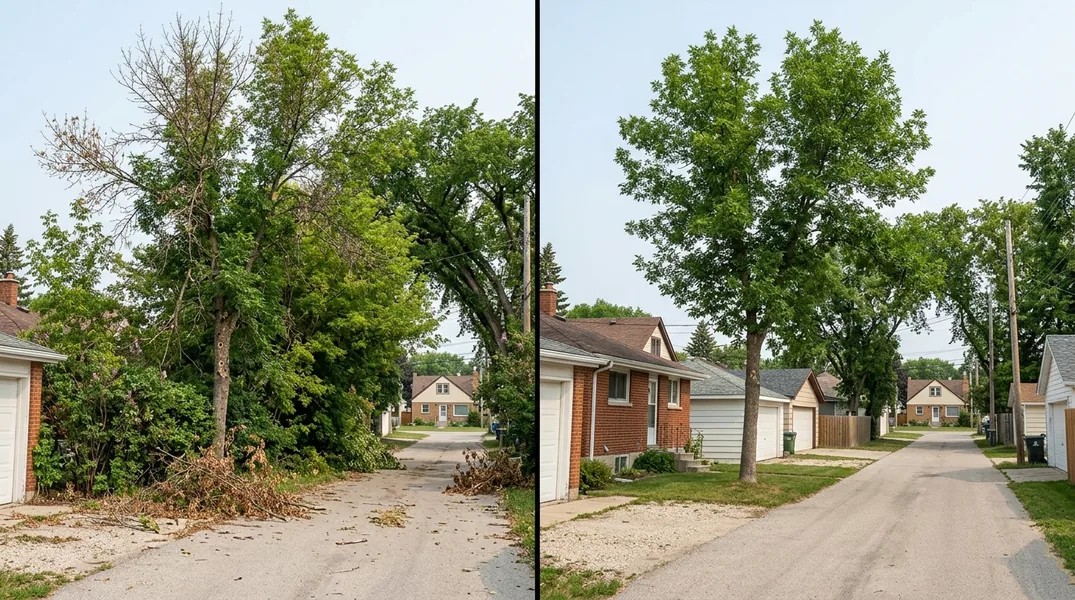
The emerald ash borer (EAB) is an invasive beetle species that has become a serious threat to ash trees across North America, including Winnipeg. This metallic green insect, native to Asia, arrived in Manitoba over a decade ago and has since spread throughout the province. The beetle's larvae feed on the inner bark of ash trees, disrupting the tree's ability to transport water and nutrients. Within just two to four years of infestation, a heavily infested ash tree can die completely.
For homeowners in Winnipeg, the presence of EAB means that any ash tree on your property is potentially at risk. The beetle does not discriminate between species of ash, though green ash and black ash are particularly common in Manitoba landscapes. If you have ash trees, understanding the threat and recognizing early warning signs can help you make informed decisions about treatment, monitoring or tree removal.
Signs of Emerald Ash Borer Damage: How to Identify an Infested Ash Tree
Recognizing the signs of emerald ash borer damage early is crucial for taking action before your tree suffers irreversible harm. One of the most distinctive indicators is the presence of D-shaped exit holes in the bark, typically about the size of a match head. These holes appear where adult beetles have emerged from the tree after completing their larval stage. You may also notice serpentine galleries or tunnels just beneath the bark surface, visible when bark peels away naturally or is damaged.
Other warning signs include crown dieback, where the upper branches of the tree begin to thin and lose leaves, often starting at the top and progressing downward. Dying ash trees in Manitoba frequently display this pattern. You might also see increased sprouting of shoots from the trunk or lower branches, which is the tree's stress response to decline. Woodpecker damage is another telltale sign, as woodpeckers are attracted to infested trees to feed on the larvae beneath the bark. If you notice any combination of these symptoms on your ash tree, contact Red River Tree Trimming at (431) 441-0851 for a professional assessment.
Should You Treat Your Ash Tree or Remove It
The decision to treat or remove an ash tree depends on several factors, including the extent of infestation, the tree's overall health, its location on your property and your budget. Professional ash tree treatment in Winnipeg typically involves the application of insecticides, most commonly trunk injections or soil drench treatments that circulate through the tree's vascular system. These treatments are most effective when applied to trees that show early signs of infestation or as a preventative measure on high-value ash trees that you wish to preserve.
However, treatment is not always the best option. If your ash tree is already heavily infested with visible crown dieback affecting more than 50 per cent of the canopy, or if the tree is in poor structural condition, removal may be the more practical and cost-effective choice. Trees that are dying from EAB infestation also pose safety risks, particularly if they are near your home, driveway or power lines. A certified arborist from Red River Tree Trimming can evaluate your specific situation and recommend whether treatment or tree removal is the best course of action. Contact us for a free estimate to discuss your options.
Is My Ash Tree Already Dead: Understanding Tree Decline Stages
Determining whether your ash tree is truly dead or simply in decline can be difficult for homeowners. A tree that appears to have no leaves or very sparse foliage may still have some living tissue, particularly in the lower trunk and roots. To test whether an ash tree still has life, you can perform a simple scratch test: use a knife or your fingernail to gently scrape a small section of the bark on a twig or small branch. If you see green tissue beneath the bark, the branch is still alive. If the tissue is brown or grey throughout, that branch is dead.
It is important to note that a tree can be partially dead, with some branches showing life while others are completely gone. Many homeowners wonder "is my ash tree dead" when they see significant crown dieback, but the presence of any green growth means the tree is still alive, even if it is in serious decline. However, a tree in advanced decline is unlikely to recover, especially if EAB is the cause. Red River Tree Trimming can provide a professional arborist assessment to determine the viability of your tree and recommend the best next steps, whether that involves treatment, monitoring, or tree removal.
Treatment Options for Emerald Ash Borer in Winnipeg
If you decide that treatment is the right choice for your ash tree, several options are available. The most common and effective treatment is a trunk injection of emamectin benzoate or similar systemic insecticide. This method involves injecting the chemical directly into the tree's vascular system, where it circulates throughout the canopy and protects against beetle larvae. Trunk injections are typically performed in late spring or early summer, before peak beetle activity, and can provide protection for one to two years per application.
Another option is a soil drench treatment, where insecticide is applied to the soil around the base of the tree and is absorbed through the root system. This method is less invasive than trunk injection but may be less effective in some cases, particularly in Winnipeg's heavy clay soils. Both methods require professional application and should only be performed by trained arborists or licensed pest management professionals. The cost of treatment varies depending on the size of the tree and the type of insecticide used. Red River Tree Trimming can provide detailed information about treatment costs and schedules during your consultation.
Replacing Ash Trees in Winnipeg: What to Plant After Removal
Once an ash tree has been removed, many homeowners want to replant in the same location to restore their landscape. Fortunately, several tree species thrive in Winnipeg's climate and can serve as excellent replacements for ash. Native species such as bur oak, Manitoba maple and basswood are well adapted to local conditions and provide similar benefits to the landscape. These alternatives offer shade, wildlife habitat and aesthetic value comparable to ash trees.
When selecting a replacement tree, consider the size of the space, the amount of sunlight available and your long-term goals for the landscape. Smaller properties may benefit from understory trees or multi-stem species, while larger yards can accommodate full-size shade trees. It is also wise to diversify your tree species rather than replanting another ash, which would face the same EAB threat. Red River Tree Trimming can advise you on suitable replacement species and can handle both the removal of your dead or dying ash tree and any tree pruning and crown reduction work needed on nearby trees. Call (431) 441-0851 to discuss your replanting options and get a free estimate for the complete project.
Looking for a professional in Winnipeg? Red River Tree Trimming responds quickly for all your tree trimming needs.
Get a free estimateOur services : Tree Removal · Tree Trimming · Tree Pruning & Crown Reduction