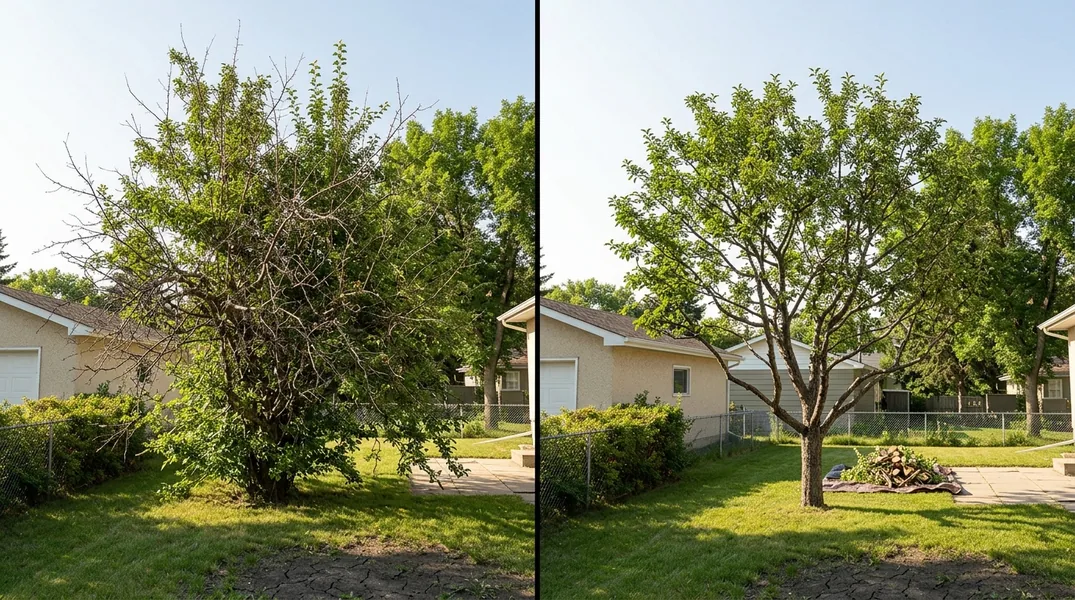
Why Wet Snow Causes More Damage Than You Expect
When October arrives in Winnipeg, many homeowners assume the worst weather has passed. Then an early snowstorm hits while trees still carry their full canopy of leaves, and suddenly branches snap under the weight. This is not the gentle, dry snow of deep winter. Wet snow is heavy, dense, and clings aggressively to every twig and leaf surface.
A single mature tree can collect hundreds of kilograms of snow when conditions are right. The problem intensifies because leaves act like collection surfaces, trapping moisture and ice. Unlike bare branches in January, which shed snow more easily, a leafed-out crown becomes a snow-catching machine. The structural load exceeds what the branch was designed to bear, especially at branch unions where wood grain runs perpendicular to the weight. Within hours, limbs that looked healthy can crack, split, or break clean off.
The damage is not always immediately obvious. Some branches hang by a thread of bark, creating a hazard that worsens over weeks as wind and further weather stress the wound. Others snap completely, leaving jagged stubs that invite disease and pest colonization. This is why quick assessment after any October storm is critical.
October Storms and Winnipeg's Vulnerable Trees
Winnipeg experiences unpredictable weather transitions in autumn. A warm September can be followed by a sudden cold snap and heavy, wet snowfall while deciduous trees are still in full leaf. Species like Manitoba maple, green ash, and American elm are particularly vulnerable because they retain dense foliage late into the season and have wood that, while strong under normal conditions, can fail under the sudden shock of heavy wet snow.
The timing of an October storm makes all the difference. Early-season snow catches trees off guard before they have hardened off for winter. The sap is still moving, tissues are still flexible, and the tree has not yet shifted resources to survival mode. When a heavy load is suddenly applied, the wood fails in ways that summer pruning cuts or wind alone would not cause. Additionally, trees weakened by disease, poor structure, or previous storm damage are far more likely to fail catastrophically.
Young trees and newly planted specimens are at elevated risk because their root systems have not fully established and their branch attachments are still developing. Even a modest snowfall can cause damage that sets back a young tree's development by years. This is why assessing your landscape after any October storm is not optional; it is a matter of safety and long-term tree health.
Recognizing Broken Branches and Hanging Limbs
After a wet snow event, walk your property and look for obvious signs of damage. Fresh breaks show exposed, light-coloured wood. Bark may be stripped or torn. A hanging branch in Winnipeg is a red flag: if a limb is attached only by bark or a thin strip of wood, it will eventually fall, and the timing is unpredictable. Never assume a partially broken branch will hold indefinitely. Wind, rain, or the weight of another storm can finish the job, and a falling branch can injure a person, damage property, or block access.
Some damage is subtle. A branch may bend under snow but not snap visibly. However, the wood fibres inside are crushed or separated, weakening the branch permanently. Over the following weeks or months, that branch may die back or fail in a wind event. This is why professional arborists recommend a thorough inspection after any major storm, even if the damage does not look severe at first glance.
Damage to the main trunk is more serious. If snow or a falling branch has stripped bark, crushed the trunk, or created a large open wound, the tree's survival and structural integrity are at risk. These situations often require professional assessment and may lead to Tree Removal if the damage is too extensive to repair safely.
Emergency Response: When to Call for Help
If a tree or large branch has fallen across a power line, a driveway, or a roof, do not attempt to remove it yourself. Contact 24/7 Emergency Tree Removal immediately. Red River Tree Trimming offers emergency response around the clock because storm damage does not wait for business hours. A downed tree can block access to your home, damage vehicles, or create a hazard for pedestrians and neighbours.
Even if the damage is not blocking access, large hanging branches or partially uprooted trees should be addressed quickly. Weather forecasts in Winnipeg often predict wind or additional precipitation within days of an October storm. A branch that is barely holding now could fall during the next wind gust. Professional arborists have the equipment, training, and insurance to handle these situations safely. Attempting a DIY removal with a chainsaw or by climbing into damaged branches risks serious injury.
Call Red River Tree Trimming at (431) 441-0851 as soon as you notice damage. We will assess the situation, advise you on the safest course of action, and provide a timeline for removal or repair. Many homeowners are surprised to learn how quickly we can respond to urgent situations in the Winnipeg area.
Preventive Pruning Before Winter Arrives
Tree Pruning & Crown Reduction in late summer or early autumn can significantly reduce the risk of storm damage. By removing dead wood, crossing branches, and weak branch unions before heavy snow arrives, you reduce the load-bearing surface and eliminate the weakest points where breaks are most likely to occur. A well-pruned tree sheds snow more efficiently because the crown is more open and snow does not accumulate as densely.
Crown reduction is particularly valuable for trees that have grown too tall or dense. Reducing the overall height and thinning the canopy lowers the centre of gravity and reduces wind resistance. This is not severe cutting; professional Tree Trimming maintains the tree's natural shape while improving structure. An ISA Certified Arborist will identify branches that are prone to failure and remove them before an October storm puts them to the test.
The best time for preventive pruning in Winnipeg is late August through September, after the hottest part of summer but well before the first heavy snow. Pruning too late in autumn can stimulate new growth that will be damaged by frost. Pruning too early in the season means new wounds have time to heal before winter stress arrives. Our team knows the local climate and can time your pruning to maximize protection and tree health.
Storm Cleanup and Debris Removal
After an October snowstorm, cleanup is often as important as damage assessment. Broken branches, fallen trees, and scattered debris create a cluttered landscape and pose ongoing safety risks. Professional 24/7 Emergency Tree Removal and cleanup services ensure that all hazardous material is removed safely and that your property is restored quickly.
Storm cleanup in Winnipeg often involves more than just dragging branches to the curb. Large limbs may need to be cut into manageable pieces. Fallen trees may need to be sectioned and removed. Debris must be cleared from roofs, gutters, and landscaping. If branches have damaged structures, fencing, or vehicles, documentation for your insurance claim is important. Red River Tree Trimming photographs damage, removes debris, and can provide a detailed report to support your claim.
The sooner cleanup happens after a storm, the better. Decomposing wood attracts insects and disease organisms. Debris piled on lawns kills grass and creates breeding grounds for pests. Professional crews have the equipment to chip smaller branches and haul larger material away, leaving your property clean and safe. Contact us at (431) 441-0851 or request a free estimate to discuss your cleanup needs.
Looking for a professional in Winnipeg? Red River Tree Trimming responds quickly for all your tree trimming needs.
Get a free estimateOur services : Tree Removal · Tree Trimming · Tree Pruning & Crown Reduction